
Guide
How to Travel Europe by Train Instead of Flying
For a lot of European routes, the train beats flying on total door-to-door time once you count airport transfers — here's when that's actually true, and when it isn't.
The instinct to fly between European cities is understandable — a flight search shows a shorter number of hours in the air, and that number is what most people compare. It's also frequently misleading, because it doesn't count getting to the airport, security, boarding, and getting from the destination airport back into the city. Add that up and a lot of short-haul flights land somewhere between three and four hours of total door-to-door time for a route a fast train covers in less, starting and ending in the city center both ways.
Where the train genuinely wins
Paris to London, via the Eurostar through the Channel Tunnel, runs about 2 hours 15 minutes, station to station. A flight covers the air time faster, but by the time you've gone through security on both ends and gotten into central London or Paris from the airport, the train is frequently the faster total option, not just the more comfortable one.
Paris to Amsterdam, on the Thalys high-speed line, takes around 3 hours 20 minutes direct. London to Amsterdam runs closer to 4 hours via the same Eurostar network extended north. Both are firmly in the range where the train's city-center-to-city-center advantage outweighs a flight's shorter time in the air.
Madrid to Barcelona, on Spain's AVE high-speed line, is one of the more dramatic examples — about 2 hours 35 minutes for a route that would otherwise mean a full airport cycle on both ends for a genuinely short flight. It's consistently cited as one of the routes where high-speed rail effectively won against domestic flying in Spain.
Paris to Barcelona, on the TGV, takes around 6 hours 25 minutes direct — long enough that this one's a genuine tradeoff rather than a clear win, but still a reasonable choice if you'd rather work, read, or sleep through the trip than deal with a flight.
Where flying still makes more sense
Longer cross-continental routes are where trains lose their advantage, mainly because there often isn't a direct high-speed option. Paris to Rome, Paris to Vienna, and Paris to Budapest all run in the range of 11 to 14 hours by train, usually involving a night train or at least one change — genuinely useful if the overnight journey doubles as accommodation, but not competitive with a two-hour flight if time matters more than the experience.
Routes crossing water without a tunnel — anything to Ireland, for instance — usually mean a combined train-and-ferry journey that takes meaningfully longer than flying, worth it only if the ferry crossing itself is part of what you want from the trip.
The practical version
Booking early matters more for trains than most people expect — European high-speed rail pricing works similarly to airlines, with the cheapest fares available weeks out and prices climbing as the date approaches. A route that costs €35 booked a month ahead can cost three or four times that a few days before departure.
For a broader look at how trains stack up against flying, driving, and the bus on cost, comfort, and CO2, the full train comparison guide covers the general tradeoffs in more depth.
Destinations mentioned in this guide
ParisParis
France
The city is laid out in twenty numbered arrondissements spiraling out from the center like a snail shell, and once that clicks, Paris stops feeling like a maze.
See full guide → Amsterdam
Amsterdam
Netherlands
There are more bikes than people registered in this city, and the bike lanes are enforced with more consequence than the actual roads — step into one without looking and you'll hear about it.
See full guide →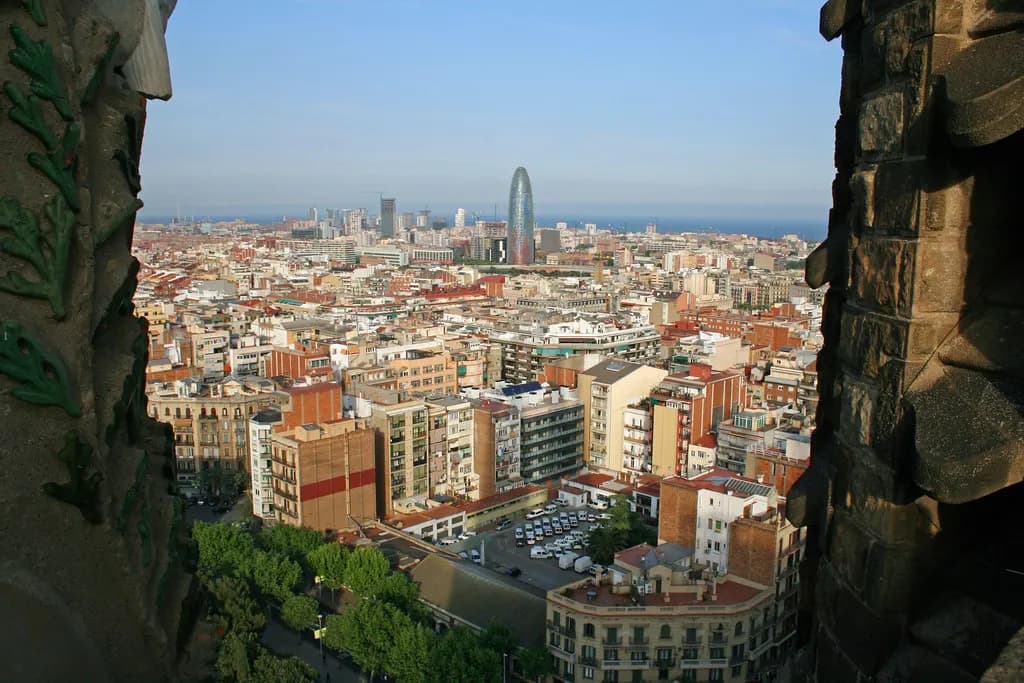 Barcelona
Barcelona
Spain
Gaudí spent over a decade on a church that's still not finished, and somehow that unfinished cathedral is now the thing everyone plans their trip around.
See full guide →