Seychelles · Africa
Seychelles
The coco de mer palm, found naturally nowhere on Earth except two Seychelles islands, produces the largest and heaviest seed of any plant known to science — for centuries, washed-up seeds found floating in the Indian Ocean led people who'd never seen the tree to believe they grew on an underwater forest.
The coco de mer, a palm tree that grows naturally nowhere on Earth except Praslin and Curieuse, two of Seychelles' 115 islands, produces the largest and heaviest seed known in the plant kingdom, some specimens exceeding 20 kilograms. For centuries before European sailors located the actual trees, seeds that washed ashore across the Indian Ocean, sometimes thousands of kilometers from Seychelles, fed genuine legends that they grew on a mythical underwater forest, since no one who found one had ever seen where it actually came from.
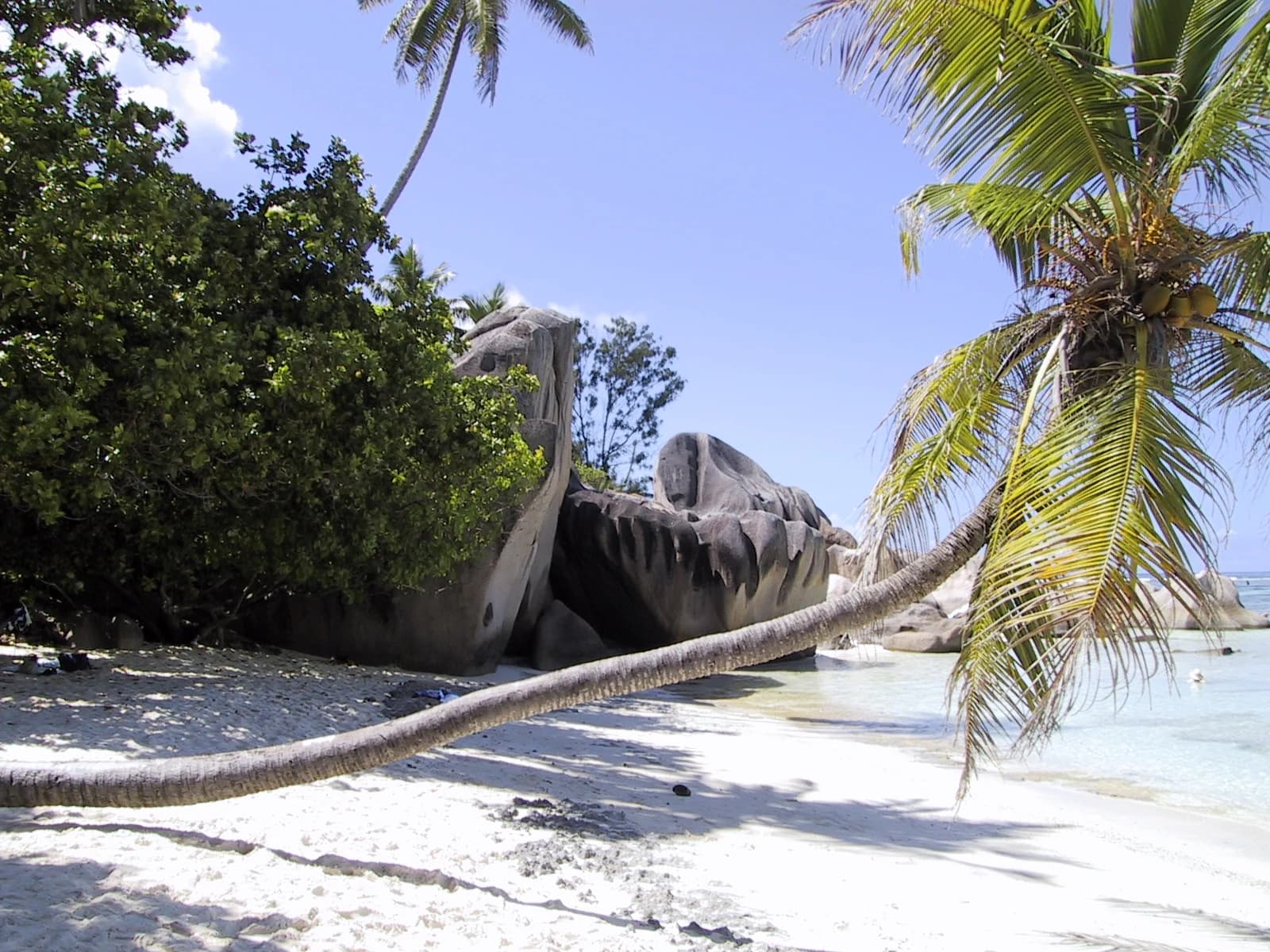
Seychelles' islands split into two distinct geological types, and that difference shapes almost everything about how the country looks and feels. The granitic inner islands, including Mahé, Praslin, and La Digue, hold dramatic boulder formations, weathered smooth over millions of years, framing beaches in a way genuinely distinct from the flat coral atolls that make up destinations like the Maldives. Anse Source d'Argent on La Digue, ringed by these granite boulders against pale sand and shallow turquoise water, has become one of the most photographed beaches anywhere in the Indian Ocean as a direct result.
Aldabra Atoll, one of Seychelles' more remote outer islands and a UNESCO World Heritage Site, holds a population of giant tortoises rivaling the Galápagos in scale, with well over 100,000 individuals, the largest such population in the world. Aldabra's extreme remoteness has kept it largely free of the invasive species and human disturbance that reduced tortoise populations on other Indian Ocean islands, making it one of the more genuinely untouched ecosystems left on Earth.
Compared to nearby Mauritius, Seychelles carries a considerably lower population density and a tourism model built more deliberately around limiting development and protecting natural reserves than maximizing resort capacity, a distinction that shows up directly in prices — Seychelles sits firmly at the luxury end of Indian Ocean travel, with relatively few budget options anywhere in the country.
Getting between Seychelles' main islands requires real planning, since Mahé, Praslin, and La Digue are connected by ferry and short domestic flights rather than roads or bridges, and most itineraries deliberately split time across at least two islands to combine Mahé's larger infrastructure with Praslin or La Digue's quieter, more scenic pace.
What a trip here actually costs
$420 / day avg.
- 4-5 star beachfront resort
- Inter-island ferry or flight between Mahé, Praslin, and La Digue
- Multi-course dinners at resort or independent restaurants
- Guided Vallée de Mai coco de mer forest tour
What to do at this tier
- • Vallée de Mai on Praslin, a UNESCO-listed palm forest and the coco de mer's primary natural habitat
- • Anse Source d'Argent on La Digue, widely photographed for its granite boulders framing pale sand and shallow turquoise water
- • Boat trip toward Aldabra Atoll or a closer reserve to see Seychelles' giant tortoise population, among the largest in the world alongside the Galápagos
These are average estimates for planning purposes, not real-time prices — actual costs vary by season, availability, and how far ahead you book.
How to get there
Click anywhere on the world map — any airport works, not just our main hubs.
Click anywhere on the map above — any airport in the world works — to see estimated travel time and cost from there.
Times and prices are planning estimates, not live fares — always check a booking site before you commit. See the full Transport Comparison guide for the general tradeoffs of each mode.
Best time to visit
April-May and October-November fall between the two monsoon seasons, generally bringing calmer winds and seas; Seychelles sits outside the main cyclone belt, so it stays visitable most of the year.
Safety notes
Very safe overall, among the more stable and low-crime destinations covered in this guide, with standard precautions around valuables at beaches and resorts.
Visa & currency
Seychellois rupee (SCR), though resort and tour prices are frequently quoted in euros or US dollars. Seychelles has one of the most open visa policies in the world, issuing a free visitor's permit on arrival to virtually all nationalities rather than requiring an advance visa.
Questions people ask before visiting
Is Seychelles worth visiting?
Yes, particularly for beach and honeymoon travel — granite boulder-lined beaches found almost nowhere else in the world, genuinely low population density, and easy island-hopping between Mahé, Praslin, and La Digue give it a distinct character from other Indian Ocean beach destinations.
What is the coco de mer?
A palm tree found naturally only on Praslin and Curieuse islands in Seychelles, producing the largest and heaviest seed of any plant species, sometimes weighing over 20 kilograms. Before the tree's actual location was known, seeds that washed ashore elsewhere in the Indian Ocean fueled legends that they grew on a mythical underwater forest.
How is Seychelles different from Mauritius or the Maldives?
Seychelles' granite islands, rather than the coral atolls that make up the Maldives, give it a distinct look — dramatic boulder formations framing the beaches rather than flat sandbars. Compared to Mauritius, Seychelles is considerably less populated and developed, with a stronger emphasis on protected nature reserves over resort density.
How many days do you need in Seychelles?
A week allows time on at least two of the three main islands, typically Mahé and Praslin or La Digue, given inter-island transport by ferry or small plane takes real planning. Seychelles sits far enough from most departure points that a shorter trip rarely justifies the flight time.
Nearby destinations
 Mauritius
Mauritius
Mauritius
The dodo lived nowhere on Earth except Mauritius, and nowhere else on Earth ever will again — the flightless bird went extinct within a century of the island's first permanent settlement, and it's now more famous globally as a symbol of extinction itself than most people realize it was ever a real, living animal from this one specific island.
See full guide → Zanzibar
Zanzibar
Tanzania
Freddie Mercury was born in Zanzibar's Stone Town in 1946, in a house still standing a short walk from the old slave market, a single block of the city holding both a global music legend's birthplace and one of the most sobering chapters of the Indian Ocean slave trade.
See full guide →Comparing more than one route? See the full transport comparison guide.