Germany · Europe
Hamburg
The Beatles didn't become the Beatles in Liverpool — they became a real band playing eight-hour nights in Hamburg's red-light district clubs years before anyone in Britain had heard of them.
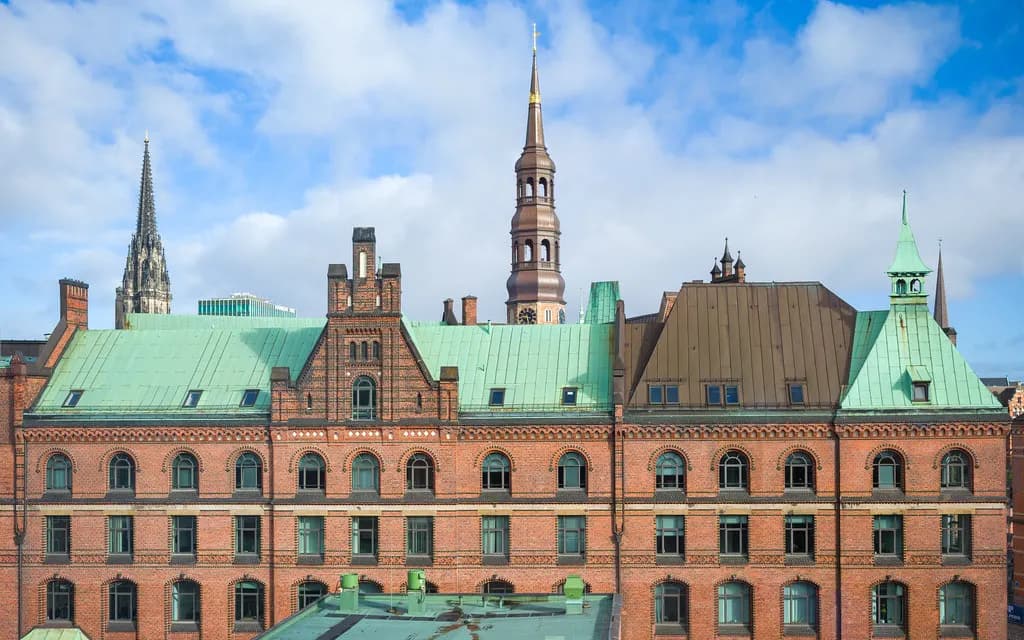
Hamburg is Germany's largest port and second-largest city, and its identity is built almost entirely around water and trade — a history that earned it the old nickname "Tor zur Welt," gateway to the world. The Speicherstadt, the warehouse district built in the late 19th century to store goods moving through the port, is the largest of its kind anywhere, an entire neighborhood of red-brick warehouses standing on timber piles driven into reclaimed marshland, and it's UNESCO-listed together with the neighboring Kontorhaus office district, whose Chilehaus building — shaped like a ship's prow — is one of the more distinctive pieces of 1920s Expressionist architecture in Germany.
At the edge of the Speicherstadt, the Elbphilharmonie concert hall, completed in 2017 after a construction process notorious for running years over schedule and wildly over budget, has become Hamburg's defining modern landmark — a glass, wave-shaped structure built on top of a preserved brick warehouse, with a public viewing plaza offering a 360-degree view of the harbor and city free with a timed entry ticket.
Hamburg's less obvious claim to fame sits in St. Pauli, on the Reeperbahn: before the Beatles were the Beatles, they were a rough, unpolished Liverpool band playing residencies in Hamburg's nightclubs between 1960 and 1962, sometimes performing eight-hour sets a night. Band members later credited those grueling Hamburg residencies specifically with turning them into a tight, professional act well before British audiences had any idea who they were — a short pedestrian street near the old club sites, Beatles-Platz, marks the connection today.
The port itself, one of the largest in Europe, remains genuinely active rather than a museum piece, and a harbor boat tour past working container terminals alongside historic ship berths gives a sense of scale that's hard to get from land.
Hamburg tends to sit in Berlin's shadow on a lot of first-time Germany itineraries, but its port history, its Speicherstadt architecture, and its own distinct water-city identity make it a genuinely different stop rather than a smaller version of the capital.
What a trip here actually costs
$55 / day avg.
- Hostel near St. Pauli or the center
- Public transit day pass
- Fish market and imbiss-stand lunches
- Free wander through Speicherstadt and the harbor
What to do at this tier
- • Walk the Speicherstadt canals and Kontorhaus district, including the Chilehaus exterior, free
- • Elbphilharmonie's public viewing platform (Plaza), free with timed entry ticket
- • Fischmarkt (fish market) on a Sunday morning, a genuine local institution, free to browse
$120 / day avg.
- 3-star hotel near the center
- Elbphilharmonie plaza and Speicherstadt Museum tickets
- Sit-down German dinners
- Harbor boat tour
What to do at this tier
- • Speicherstadt Museum, covering the warehouse district's trading history
- • Harbor boat tour through one of Europe's largest ports
- • Reeperbahn history walk, including Beatles-Platz, best done outside peak nightlife hours
$260 / day avg.
- 4-5 star hotel with harbor views
- Elbphilharmonie concert tickets
- Private guided Speicherstadt and port history tour
- Multi-course seafood dinner
What to do at this tier
- • Concert at the Elbphilharmonie, one of the more architecturally striking concert halls in Europe
- • Private guided tour connecting the port's trading history with the Speicherstadt and Kontorhaus
- • Multi-course seafood-focused dinner reflecting Hamburg's maritime trade history
These are average estimates for planning purposes, not real-time prices — actual costs vary by season, availability, and how far ahead you book.
How to get there
Click anywhere on the world map — any airport works, not just our main hubs.
Click anywhere on the map above — any airport in the world works — to see estimated travel time and cost from there.
Times and prices are planning estimates, not live fares — always check a booking site before you commit. See the full Transport Comparison guide for the general tradeoffs of each mode.
Best time to visit
May-September brings the mildest, driest weather; winters are cold, damp, and windy given the city's exposure to the North Sea via the Elbe.
Safety notes
Very safe overall. The Reeperbahn area is livelier and warrants normal nightlife-district caution at night, but isn't unusually dangerous.
Visa & currency
Euro. Standard Schengen 90-day visa-free rule applies for most Western passport holders.
Questions people ask before visiting
Is Hamburg worth visiting?
Yes — it's Germany's largest port and second-largest city, with the Speicherstadt warehouse district (the largest of its kind in the world, UNESCO-listed), the striking Elbphilharmonie concert hall, and a genuine Beatles history that predates their British fame, all things Berlin or Munich don't offer.
Is the Speicherstadt worth visiting?
Yes — it's the largest warehouse district in the world, built on timber piles over reclaimed land in the late 19th century, and it's UNESCO-listed alongside the neighboring Kontorhaus office district, which includes the striking, ship-prow-shaped Chilehaus. Walking the canals at night, when the brick facades are lit, is a genuinely different experience from the daytime version.
What's the Beatles connection to Hamburg?
Before they were famous in Britain, the Beatles played long, grueling residencies in Hamburg's Reeperbahn nightclubs between 1960 and 1962 — eight-hour sets some nights — which is widely credited, including by the band members themselves, with turning them from an amateur act into a tight, road-hardened band. A short pedestrian street near the clubs, Beatles-Platz, marks the history today.
Hamburg or Berlin — which should I prioritize?
Berlin has the deeper 20th-century political history and a bigger, more famous museum and nightlife scene. Hamburg offers a genuinely different identity built around its port, water, and maritime trade history, plus a more compact, walkable center. Many travelers combine both on a longer Germany trip rather than choosing one.
How many days do you need in Hamburg?
Two days covers the Speicherstadt, Elbphilharmonie, and the harbor. A third day allows a proper look at the Reeperbahn's history beyond nightlife, or a boat tour of the port, one of the largest in Europe.
Nearby destinations
 Berlin
Berlin
Germany
A city that was physically split in two for 28 years now has almost no visible seam — you can walk from what was the Soviet-controlled east into the former West Berlin without noticing, unless you know exactly where to look.
See full guide → Copenhagen
Copenhagen
Denmark
An amusement park older than the Eiffel Tower still runs in the middle of downtown, right next to the restaurant that spent years being called the best in the world.
See full guide →Comparing more than one route? See the full transport comparison guide.