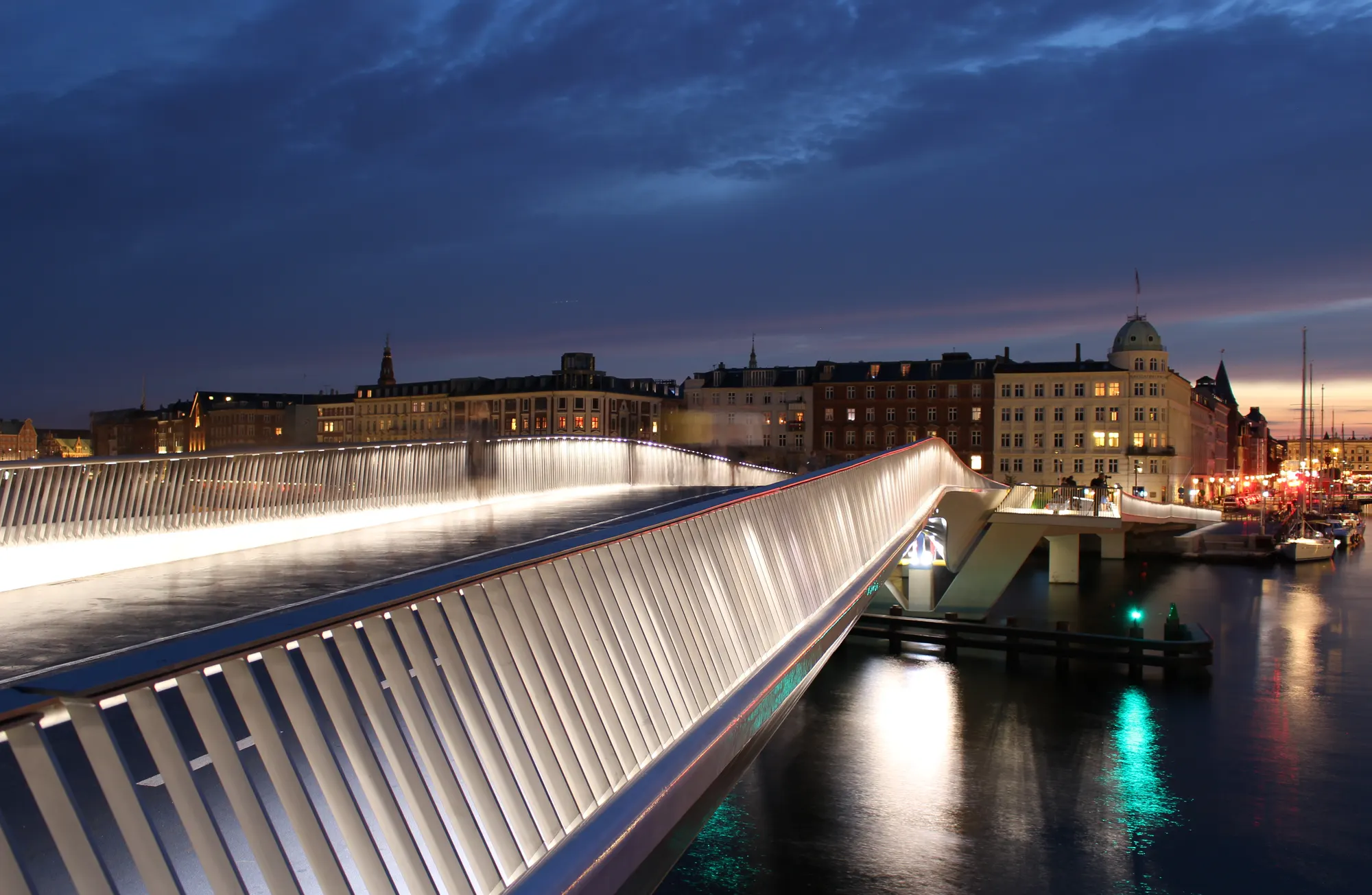
Denmark · Europe
Copenhagen
An amusement park older than the Eiffel Tower still runs in the middle of downtown, right next to the restaurant that spent years being called the best in the world.
Tivoli Gardens sits a few minutes' walk from Copenhagen's central station, and it's easy to underestimate on paper — an amusement park downtown sounds like a quick, kid-focused stop. It opened in 1843, makes it one of the oldest operating amusement parks in the world, and it's widely reported that Walt Disney visited and drew inspiration from it decades before Disneyland existed. By evening, when the gardens light up and the crowd skews toward couples and groups of friends rather than families, it reads less like a theme park and more like a genuinely well-designed public space that happens to have roller coasters in it.
Copenhagen's food reputation shifted hard in the 2000s and 2010s around the New Nordic movement — restaurants built around hyperlocal, seasonal Scandinavian ingredients, foraged greens, and techniques that broke from the French-dominated fine dining standard. Noma, at the center of that movement, spent years topping "world's best restaurant" lists before closing its original format; its influence is still visible across the city's restaurant scene even where the prices are far more accessible than a Noma tasting menu ever was.
Christiania, a self-declared autonomous neighborhood founded by squatters in 1971, still operates with its own informal rules distinct from the rest of the city. The area is generally safe and interesting to walk through during the day, with a mix of alternative architecture and community art — but "Pusher Street," where cannabis is sold openly despite it remaining illegal in Denmark, has a strict no-photography rule that's enforced, sometimes forcefully. Keep the phone in your pocket on that specific stretch and the rest of Christiania is a low-friction, worthwhile visit.
Biking is close to the default way locals get around, not a tourist novelty — Copenhagen is flat, the bike lane network is extensive and physically separated from car traffic in most of the city, and cyclists have real priority at intersections. Renting a bike for a day covers more ground than walking without the cost or hassle of taxis.
Copenhagen is not a cheap city, and it's worth budgeting for that honestly rather than expecting Southern European prices. Food and drink specifically run high — a casual dinner out or a round of beers adds up faster than in Lisbon or Prague — though public transit and museum pricing are more in line with other major Western European capitals.
What a trip here actually costs
$95 / day avg.
- Hostel outside the immediate center, metro-accessible
- Bike rental instead of transit passes
- Bakery lunches, smørrebrød from a casual spot
- Free wander through Nyhavn and Christianshavn
What to do at this tier
- • Walk Nyhavn's colorful harbor front, free, best early morning before the crowds
- • Christianshavn's canals and Christiania's daytime streets, camera away on Pusher Street
- • The Little Mermaid statue, more a checklist stop than a highlight, but quick and free
$210 / day avg.
- 3-star hotel near the center or Vesterbro
- Tivoli Gardens entry with ride pass
- Sit-down New Nordic-influenced dinner
- Design Museum or National Museum entry
What to do at this tier
- • Tivoli Gardens, a full evening, rides plus the illuminated gardens after dark
- • Smørrebrød lunch at a proper spot, not a tourist-menu version
- • Design Museum Denmark or the National Museum for a rainy-day option
$450 / day avg.
- 4-5 star hotel near Nyhavn or the harbor
- Tasting menu at a high-end New Nordic restaurant
- Private harbor canal tour
- Day trip to Malmö or Kronborg Castle with a private guide
What to do at this tier
- • Tasting menu at a New Nordic restaurant, booked well ahead
- • Private canal boat tour through the harbor and Christianshavn
- • Day trip to Kronborg Castle, the real-world setting associated with Shakespeare's Hamlet
These are average estimates for planning purposes, not real-time prices — actual costs vary by season, availability, and how far ahead you book.
How to get there
Click anywhere on the world map — any airport works, not just our main hubs.
London is one of our researched reference cities — every mode below is hand-checked, not a formula.
| Mode | Time | Approx. cost | Notes |
|---|---|---|---|
| Flight | 1h55 | $50-155 | Fastest option; book 6-8 weeks out for the lower end of the range. |
Times and prices are planning estimates, not live fares — always check a booking site before you commit. See the full Transport Comparison guide for the general tradeoffs of each mode.
Best time to visit
May through August brings the longest daylight hours and the mildest weather; winter is short on daylight and genuinely cold.
Safety notes
Very safe overall, among the safer major European capitals. The only specific caution is avoiding photography on Christiania's Pusher Street.
Visa & currency
Danish krone (DKK), not the euro, despite EU membership. Standard Schengen 90-day visa-free rule applies for most Western passport holders.
Questions people ask before visiting
Is Copenhagen expensive to visit?
Yes, consistently one of the more expensive cities in Europe for food and drink specifically — a casual restaurant meal or a beer at a bar costs noticeably more than in Southern or Central Europe. Accommodation is comparable to other major Western European capitals rather than dramatically higher.
Is Christiania safe to visit as a tourist?
Generally yes during the day. It's a semi-autonomous neighborhood with an open, informally tolerated cannabis market on 'Pusher Street' specifically — photography is banned there and taken seriously, sometimes aggressively enforced, so keep the camera away on that one stretch and it's a low-friction visit.
Is Tivoli Gardens worth visiting as an adult without kids?
Yes — it opened in 1843, predates the Eiffel Tower, and reportedly influenced Walt Disney's vision for Disneyland. It's as much a landscaped garden and evening lights spectacle as a ride park, which makes it work for a couple's evening as easily as a family day.
Do I need a bike to see Copenhagen properly?
Not strictly, but it helps — the city is flat, the bike infrastructure is extensive and safer than in most capitals, and a lot of locals genuinely commute this way rather than driving. Rental bikes are widely available and a reasonable way to cover more ground than walking allows.
How many days do you need in Copenhagen?
Three days covers Nyhavn, Tivoli, and one of the design or history museums comfortably. A fourth allows a slower look at Christiania and Christianshavn, or a day trip to Malmö, Sweden, just across the bridge.
Nearby destinations
 Amsterdam
Amsterdam
Netherlands
There are more bikes than people registered in this city, and the bike lanes are enforced with more consequence than the actual roads — step into one without looking and you'll hear about it.
See full guide → Reykjavik
Reykjavik
Iceland
The tap water comes straight from glacial springs and most homes are heated by the ground itself — geothermal energy covers virtually all of the city's heating, which is the quiet fact behind almost everything you'll notice here.
See full guide →Comparing more than one route? See the full transport comparison guide.