New Zealand · Oceania
Rotorua
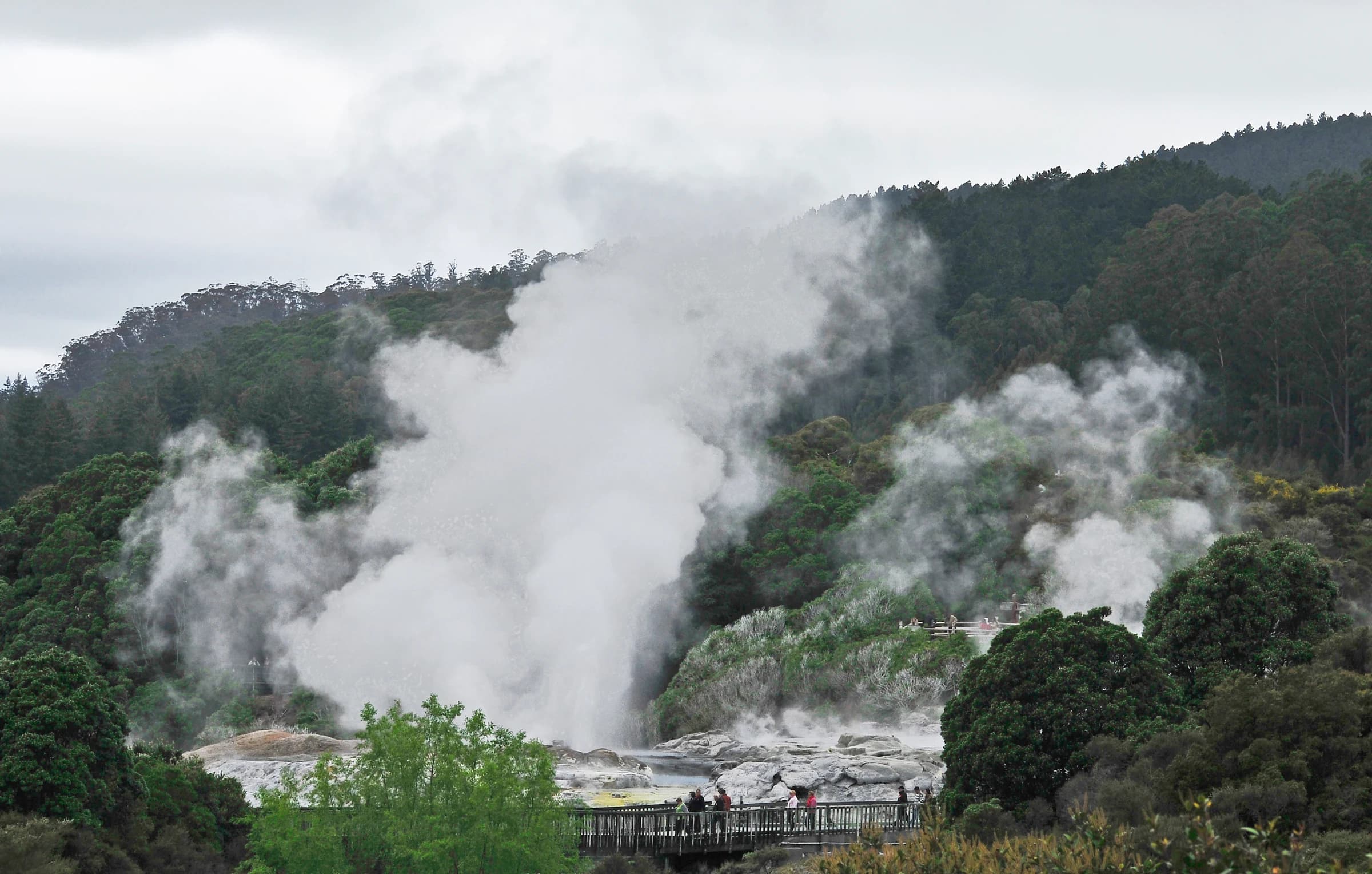
Rotorua sits on such intense geothermal activity that the whole town carries a faint sulfur smell locals have long since stopped noticing — geysers erupt on schedule, mud pools bubble in public parks, and the ground itself occasionally opens into new hot springs without much warning.
Rotorua sits directly on one of the most active geothermal fields in New Zealand, and that activity is genuinely impossible to ignore. Hydrogen sulfide gas released continuously from the area's geysers, mud pools, and hot springs gives the whole town a persistent rotten-egg smell, one locals have largely stopped noticing but that catches nearly every first-time visitor off guard, earning the town the long-running, mostly affectionate nickname "Rotten-rua."
Kuirau Park, a free public park right in the middle of town, makes that geothermal activity strikingly visible without any entry fee: steaming ground, bubbling mud pools, and small geothermal pools sit alongside ordinary park paths and playgrounds, a genuinely unusual juxtaposition of everyday municipal park and active volcanic feature.
Further out, Te Puia combines geothermal sightseeing with something considerably deeper: it's home to Pohutu Geyser, one of the most reliably active geysers in the Southern Hemisphere, alongside a genuine working institute for traditional Maori arts and crafts, where visitors can watch carvers and weavers actively practicing skills passed down through generations rather than viewing static museum displays.
Rotorua functions as one of New Zealand's most significant centers for experiencing living Maori culture directly, and evening cultural performances combining haka, traditional song, and a hangi feast, food cooked using geothermal steam and heat in an underground earth oven, give visitors a genuine, still-actively-practiced tradition rather than a purely historical reenactment.
Wai-O-Tapu Thermal Wonderland, a short drive from town, rounds out the geothermal sightseeing with some of the most vividly colored mineral pools in the country, ranging through greens, oranges, and yellows produced by different mineral concentrations in the water, a genuinely striking sight that photographs consistently struggle to fully capture.
What a trip here actually costs
$45 / day avg.
- Guesthouse or hostel in central Rotorua
- Local bus fares
- Casual meals
- Kuirau Park geothermal walk, free
What to do at this tier
- • Kuirau Park, a free public park with bubbling mud pools and steaming ground
- • Government Gardens and the Rotorua Museum exterior, free to walk
- • Lake Rotorua waterfront wander, free
$110 / day avg.
- 3-star hotel near the lake
- Te Puia geothermal park and cultural show entry
- Traditional hangi feast dinner
- Wai-O-Tapu geothermal wonderland entry
What to do at this tier
- • Te Puia, combining Pohutu Geyser viewing with a working Maori arts and crafts institute
- • Wai-O-Tapu Thermal Wonderland, known for its vividly colored geothermal pools
- • Traditional hangi feast and Maori cultural performance, including haka
These are average estimates for planning purposes, not real-time prices — actual costs vary by season, availability, and how far ahead you book.
How to get there
Click anywhere on the world map — any airport works, not just our main hubs.
Click anywhere on the map above — any airport in the world works — to see estimated travel time and cost from there.
Times and prices are planning estimates, not live fares — always check a booking site before you commit. See the full Transport Comparison guide for the general tradeoffs of each mode.
Best time to visit
December-February and March-May bring the most comfortable weather; geothermal sights are visitable year-round regardless of season.
Safety notes
Generally very safe for tourists; stay on marked paths at geothermal sites given genuinely hot ground and unstable surfaces in some areas.
Visa & currency
New Zealand dollar (NZD). Most visa-waiver nationalities need a New Zealand Electronic Travel Authority (NZeTA), an online application required since 2019, arranged before arrival.
Questions people ask before visiting
Is Rotorua worth visiting?
Yes — its intense geothermal activity, including active geysers and bubbling mud pools, is genuinely unusual to see up close, and Rotorua also functions as one of New Zealand's most significant centers for experiencing living Maori culture directly rather than through a museum alone.
Why does Rotorua smell like sulfur?
Rotorua sits directly on an active geothermal field, and the hydrogen sulfide gas released by that activity, geysers, mud pools, and hot springs scattered throughout and around the town, produces a persistent rotten-egg smell that's become something of a local in-joke, with the town sometimes nicknamed 'Rotten-rua.'
What Maori cultural experiences are available in Rotorua?
Several venues offer genuine cultural performances including haka and traditional song, alongside hangi feasts cooked using geothermal heat, a traditional Maori cooking method. Te Puia, which combines geothermal sights with a working Maori arts and crafts institute, is one of the most established options.
How many days do you need in Rotorua?
Two days covers a geothermal park visit, like Te Puia or Wai-O-Tapu, plus a Maori cultural evening including a hangi feast. It works well as a stop between Auckland and other North Island destinations.
Nearby destinations
 Auckland
Auckland
New Zealand
Auckland is built directly on top of an active volcanic field — around 50 volcanic cones dot the city and its surroundings, and while most are considered dormant rather than truly extinct, a new eruption could theoretically happen almost anywhere within the field, including somewhere that isn't currently a volcano at all.
See full guide → Queenstown
Queenstown
New Zealand
Commercial bungy jumping was invented right here — AJ Hackett's first jump off the Kawarau Bridge in 1988 turned Queenstown into what's now genuinely called the adventure capital of the world, and that same bridge still runs bungy jumps today, largely unchanged since the sport's invention.
See full guide →Comparing more than one route? See the full transport comparison guide.