Zimbabwe · Africa
Victoria Falls
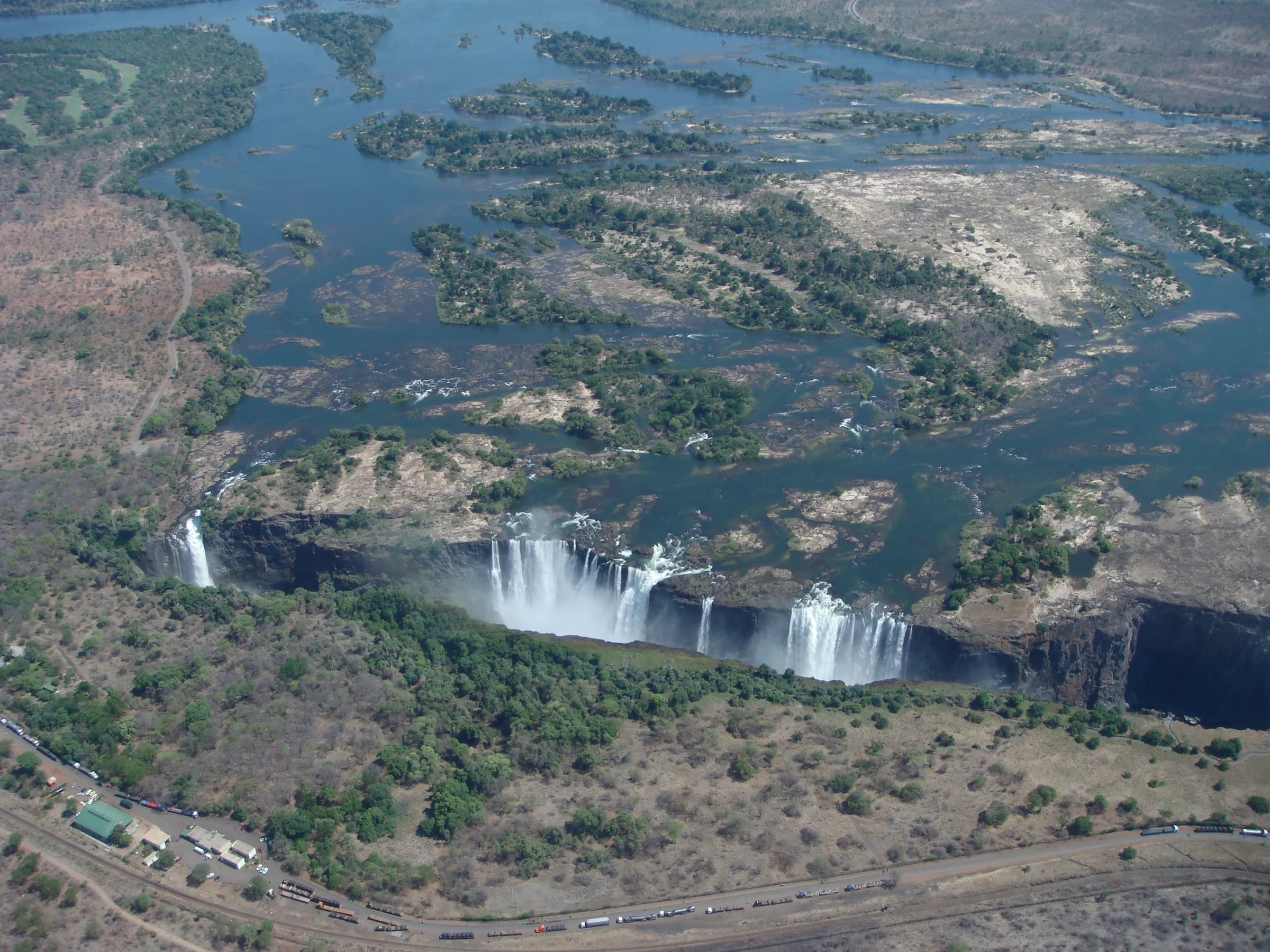
Locals called it Mosi-oa-Tunya, 'The Smoke That Thunders,' long before David Livingstone ever saw it in 1855 — the spray from the falls rises high enough to be visible from more than 20 kilometers away, which is exactly why the name stuck.
Long before Scottish missionary and explorer David Livingstone became the first European to see the falls in 1855, local Kololo and Lozi communities called it Mosi-oa-Tunya, "The Smoke That Thunders." The name describes something visitors still notice from a considerable distance: spray thrown up by the falling water rises high enough to be visible from more than 20 kilometers away, a genuine cloud that gave the site its name centuries before Livingstone renamed it after Queen Victoria.
By the specific metric of width combined with height, Victoria Falls is classified as the largest sheet of falling water in the world, stretching roughly 1,708 meters across and dropping about 108 meters, more than double Niagara Falls' height. Neither the tallest nor the widest waterfall individually, it's the combination of both dimensions at this scale that sets it apart, and standing at one of the viewpoints along the gorge makes that scale difficult to take in all at once.
The falls sit directly on the border between Zimbabwe and Zambia, and each side offers a genuinely different experience. Zimbabwe's side, accessed from Victoria Falls town, gives broader, more panoramic frontal views across nearly the whole width of the falls. Zambia's side, from the town of Livingstone, gets visitors closer to the edge, including access during low-water months to Devil's Pool, a natural rock pool right at the lip of the falls where swimmers can look directly over the drop.
The KAZA UniVisa, a joint tourist visa covering both Zimbabwe and Zambia plus day access into Botswana's Kazungula area, makes seeing both sides of the falls, and potentially a same-trip visit to Chobe National Park's elephant herds, considerably more practical than arranging separate visas for each country would be.
Beyond the falls themselves, the surrounding area has built a genuine adventure tourism industry around the Zambezi Gorge: whitewater rafting through Batoka Gorge ranks among the more serious commercial rafting runs in the world, bungee jumping and gorge swings operate from the Victoria Falls Bridge spanning the two countries, and sunset cruises on the calmer water above the falls offer a considerably gentler way to spend an evening on the river.
What a trip here actually costs
$130 / day avg.
- 3-star lodge in Victoria Falls town
- Falls national park entry
- Sit-down dinners including a boma-style cultural dinner
- Sunset Zambezi River cruise
What to do at this tier
- • Victoria Falls National Park walking trail, covering multiple viewpoints along the Zimbabwe side
- • Sunset cruise on the Zambezi River above the falls, wildlife and hippo sightings common
- • Boma-style dinner with traditional dance and a local food buffet
$350 / day avg.
- 4-5 star lodge overlooking the Zambezi
- Helicopter flight over the falls
- Private guided whitewater rafting or bungee jump booking
- Multi-course dinner at a riverside lodge restaurant
What to do at this tier
- • Helicopter flight over the falls, giving the full aerial view of the gorge and spray
- • Whitewater rafting through the Batoka Gorge below the falls, among the world's more intense commercial rafting runs
- • Bungee jump or gorge swing from the Victoria Falls Bridge, spanning the border between Zimbabwe and Zambia
These are average estimates for planning purposes, not real-time prices — actual costs vary by season, availability, and how far ahead you book.
How to get there
Click anywhere on the world map — any airport works, not just our main hubs.
Click anywhere on the map above — any airport in the world works — to see estimated travel time and cost from there.
Times and prices are planning estimates, not live fares — always check a booking site before you commit. See the full Transport Comparison guide for the general tradeoffs of each mode.
Best time to visit
May-October, the dry season, gives the clearest views of the falls' full face before water volume drops later in the season; higher water in the wet season (roughly November-April) means more spray, sometimes enough to obscure the view entirely from certain points.
Safety notes
Generally safe for tourists around the falls and main town areas; Zimbabwe's currency situation has been unstable for years, so carrying US dollars in cash for most transactions is standard practice rather than relying on local currency.
Visa & currency
Zimbabwe introduced a new currency, the ZiG, in 2024 after previous currencies collapsed under hyperinflation; US dollars remain widely used and often preferred in practice. The KAZA UniVisa covers both Zimbabwe and Zambia entry plus day trips into Botswana, and most Western nationalities can obtain it on arrival.
Questions people ask before visiting
Is Victoria Falls worth visiting?
Yes — it's classified as the largest sheet of falling water in the world, roughly twice the height of Niagara Falls, and the surrounding national parks on both the Zimbabwe and Zambia sides add wildlife viewing, whitewater rafting, and bungee jumping to the waterfall itself.
Should I visit Victoria Falls from Zimbabwe or Zambia?
Zimbabwe's side, from the town of Victoria Falls, gives the more panoramic frontal views and generally better tourism infrastructure. Zambia's side, from Livingstone, offers closer access to the falls' edge, including Devil's Pool during low-water months. Many visitors cross between both using the KAZA UniVisa, which covers day trips across the border.
What is the KAZA UniVisa?
A joint tourist visa covering Zimbabwe and Zambia, and permitting day trips into Botswana's Kazungulu area, that lets visitors see the falls from both sides and access nearby Chobe National Park without needing separate visas for each country — a genuine practical convenience given how closely the sites sit together.
How many days do you need at Victoria Falls?
Two to three days covers the falls themselves from at least one side, plus one adventure activity like whitewater rafting or a helicopter flight. Many visitors combine it with a few days at a nearby safari lodge, since Zimbabwe's Hwange National Park and Botswana's Chobe are both within reach.
Nearby destinations
Comparing more than one route? See the full transport comparison guide.