South Africa · Africa
Johannesburg
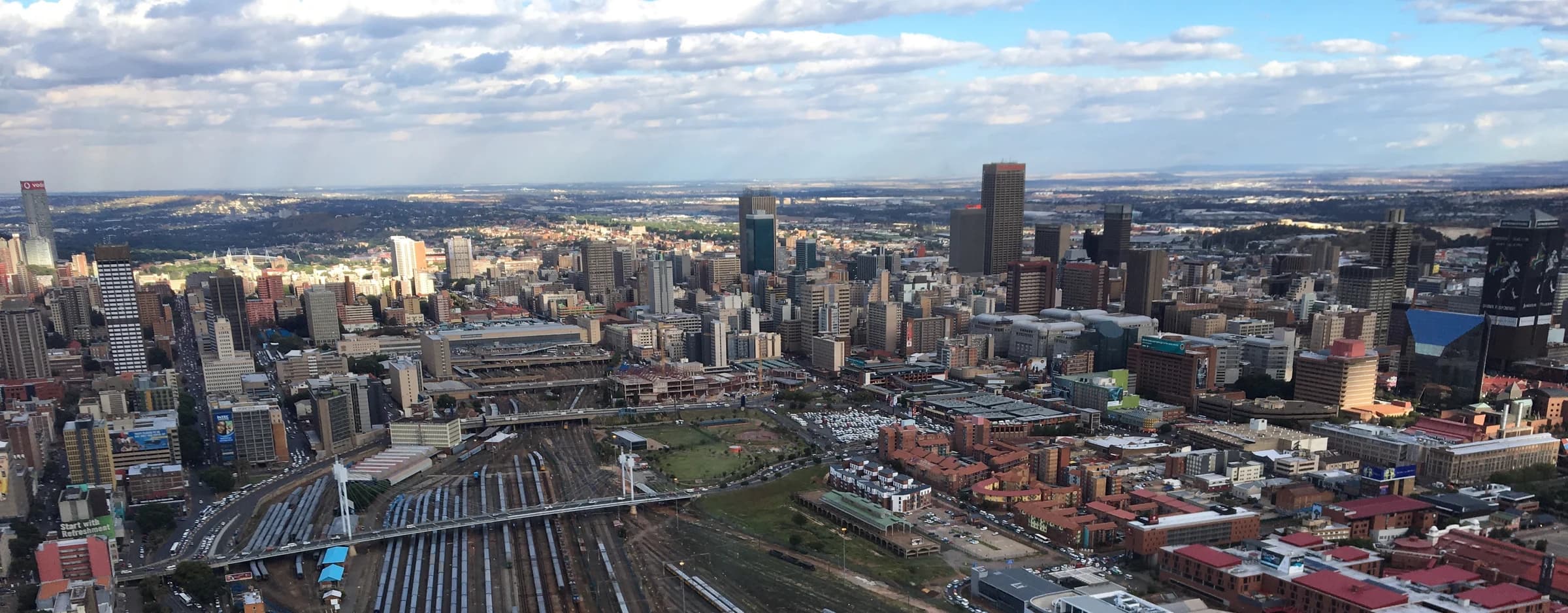
Johannesburg didn't exist before 1886 — the city was founded almost overnight after gold was discovered on the Witwatersrand ridge, and that gold rush origin still shapes a metropolis with no old colonial core to speak of, built instead around mining wealth and, later, the front lines of the anti-apartheid movement.
Johannesburg didn't exist before 1886. The city sprang up almost overnight after gold was discovered on the Witwatersrand ridge, drawing prospectors and mining companies fast enough that Johannesburg had no gradual colonial-era development the way older South African cities did — it was built directly around mineral wealth, and its layout and early growth still reflect that mining-camp-turned-metropolis origin more than any older civic tradition.
That same rapid, resource-driven growth later put Johannesburg at the center of South Africa's anti-apartheid struggle, and the city holds that history more directly than anywhere else in the country. The Apartheid Museum, opened in 2001, walks visitors through the segregation era using original documents, photographs, and film in a sequence designed to be genuinely uncomfortable rather than sanitized, a deliberate curatorial choice.
Soweto, a township on Johannesburg's southwest edge that grew explosively under apartheid-era forced relocations, holds Vilakazi Street, the only street anywhere in the world where two Nobel Peace Prize laureates once lived: Nelson Mandela and Archbishop Desmond Tutu, both former residents within walking distance of each other. Nearby, the Hector Pieterson Memorial marks the site of the 1976 Soweto Uprising, when police opened fire on students protesting the enforced use of Afrikaans in schools, a turning point that drew international attention to apartheid's brutality.
Constitution Hill, a former prison complex that once held Mahatma Gandhi and Nelson Mandela among many others, now houses South Africa's Constitutional Court, a deliberate transformation of a site built for oppression into one built around constitutional rights, with much of the original prison architecture preserved alongside the new court building.
Johannesburg sits at roughly 1,750 meters above sea level, an elevation that moderates its climate considerably compared to what its latitude alone would suggest, giving the city sunny, mild days and cool nights for most of the year rather than the more extreme heat found in lower-lying parts of South Africa.
What a trip here actually costs
$30 / day avg.
- Guesthouse in a secure northern suburb
- Uber or arranged transfers
- Casual South African meals
- Constitution Hill entry
What to do at this tier
- • Constitution Hill, a former prison complex now home to South Africa's Constitutional Court, entry fee applies
- • Maboneng Precinct, a revitalized arts and design district, free to wander
- • Nelson Mandela Bridge and central business district viewpoints, free
$75 / day avg.
- 3-star hotel in Sandton or Rosebank
- Apartheid Museum and guided Soweto tour
- Sit-down dinners at Maboneng or Sandton restaurants
- Half-day Lion Park or wildlife day trip
What to do at this tier
- • Apartheid Museum, covering South Africa's segregation era through original artifacts and documentary footage
- • Guided tour of Soweto, including Vilakazi Street and the Hector Pieterson Memorial
- • Half-day trip to a wildlife reserve within driving distance of the city
$200 / day avg.
- 4-5 star hotel in Sandton
- Private guided Apartheid Museum and Soweto history tour
- Multi-course dinner at a top Johannesburg restaurant
- Private day trip toward the Cradle of Humankind
What to do at this tier
- • Private guided full day covering the Apartheid Museum, Soweto, and Constitution Hill in depth
- • Day trip to the Cradle of Humankind, a UNESCO World Heritage Site holding some of the richest early hominid fossil finds anywhere
- • Multi-course dinner at a leading Johannesburg restaurant in Sandton or Rosebank
These are average estimates for planning purposes, not real-time prices — actual costs vary by season, availability, and how far ahead you book.
How to get there
Click anywhere on the world map — any airport works, not just our main hubs.
Click anywhere on the map above — any airport in the world works — to see estimated travel time and cost from there.
Times and prices are planning estimates, not live fares — always check a booking site before you commit. See the full Transport Comparison guide for the general tradeoffs of each mode.
Best time to visit
April-October, the Southern Hemisphere dry season, brings sunny days and cool nights; Johannesburg sits at roughly 1,750 meters elevation, which keeps temperatures milder year-round than the latitude alone would suggest.
Safety notes
Requires more planning than Cape Town — arrange transport in advance rather than walking between sights, avoid the central business district and unfamiliar areas after dark, and consider a guided tour for Soweto rather than visiting independently.
Visa & currency
South African rand (ZAR). Many Western passport holders can enter visa-free for short stays, worth confirming before booking.
Questions people ask before visiting
Is Johannesburg worth visiting?
Yes, particularly for travelers interested in 20th-century history — the Apartheid Museum and Soweto's Vilakazi Street give Johannesburg a direct connection to the anti-apartheid movement that Cape Town, more scenic but less politically central, doesn't offer in the same depth.
Is Johannesburg safe to visit?
It requires more deliberate planning than Cape Town — Johannesburg has a genuinely higher crime rate in parts of the city, and most visitors get around via arranged transport or guided tours rather than walking between sights, particularly in the central business district and after dark anywhere in the city.
What is Vilakazi Street in Soweto?
A street in the Soweto township that's the only street in the world where two Nobel Peace Prize laureates once lived: Nelson Mandela and Archbishop Desmond Tutu, whose former homes sit within walking distance of each other.
How many days do you need in Johannesburg?
Two days covers the Apartheid Museum, a guided Soweto tour including Vilakazi Street, and Constitution Hill. Many visitors treat Johannesburg as a short historical stop before flying on to Cape Town or a safari destination like Kruger National Park.
Nearby destinations
Comparing more than one route? See the full transport comparison guide.